Wilhelm Treue Art Plunder Trans Basil Creighton New York John Day 1961
| The Stolen Buss | |
|---|---|
| fr: Le Baiser à la dérobée | |
 | |
| Artist | Jean-Honoré Fragonard and/or Marguerite Gérard Run into § Attribution |
| Year | late 1780s[one] |
| Catalogue | GW 523; C 383 |
| Medium | Oil on sail[1] |
| Dimensions | 45 cm × 55 cm (xviii in × 22 in)[i] |
| Location | Hermitage Museum[1] [2], St. petersburg, Russia |
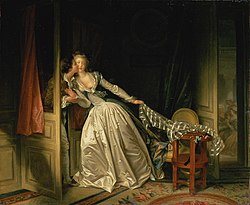
The Stolen Kiss is an oil on canvass painting from the terminate of the 1780s, located in the Hermitage Museum, Saint Petersburg. It has been historically attributed to the French Rococo artist Jean-Honoré Fragonard (1732–1806). At 45 by 55 centimetres (xviii in × 22 in), the painting is a genre scene influenced by Dutch Gold Age painting, depicting a young couple in a secretive romance, set in the foreground — a subject that was favoured before the French Revolution amid French aristocrats.[one]
In the belatedly 18th century, The Stolen Kiss belonged to Stanisław Baronial Poniatowski, the last monarch of the first Rzechpospolita, and was hosted in the Lazienki Palace in Warsaw. With the conquering of the palace in the early 19th century past Tsar Alexander I, the painting effectively became role of the Russian imperial collections. It was transferred in 1895 to the Hermitage Museum, where information technology remains.
The traditional attribution of The Stolen Osculation to Fragonard is based on a mention of him equally the author, with an etching of the painting published in 1788. Nevertheless, information technology has been noted that the way of the painting, though close to Fragonard'due south works such equally The Commodities, is more characteristic of the artist'south sis-in-law and apprentice, Marguerite Gérard; because of that, some scholars consider the painting to be either a collaboration of Gérard and Fragonard, or solely a Gérard work.
History [edit]

The primeval dated mention of The Stolen Kiss comes from the June 1788 upshot of the Mercure de French republic magazine, where an engraving by Nicolas François Regnault of Fragonard's painting has been advertised as a pendant to The Bolt.[3] : 95 [4]
Before long after in the 1790s, the work was purchased past Stanisław August Poniatowski, the last monarch of the first Rzechpospolita; information technology was present in the catalogue of the Royal Picture Gallery at the Lazienki Palace in Warsaw in 1795. Perhaps it was bought at one of the auctions, which sold goods of the French aristocracy following the Revolution of 1789. This would explain the silence of the sources about the acquisition of the work and its certain formal and thematic incompatibility with the other works of the drove. Poniatowski highly valued The Stolen Kiss, and was willing to accept it taken from Warsaw to St. petersburg upon his abdication in 1795; the shipment did not take identify, though.
After Poniatowski's death in 1798, his collection at the Lazienki Palace was formally succeeded by the nephew, Józef Poniatowski, and later past the latter'due south sister Maria Teresa, who sold the palace in 1817 to Tsar Alexander I, effectively making The Stolen Kiss role of the Russian imperial collection.[five] The painting remained in the Lazienki Palace until 1895, when it was transferred to the Hermitage following a report from the imperial collection curator Andrei Somov, who recommended The Stolen Kiss, with four other paintings from Stanisław Baronial's collection, to be present in the Hermitage on conservation and accessibility concerns.[half dozen] [7]
Afterward regaining independence in 1918 first, and subsequently after the end of Earth State of war II in 1945, the Smoothen government made diplomatic efforts to recover the painting. In the lite of international law and arrangements with the authorities of the Soviet Union, the painting equally work of fine art of national importance taken by Russians from Poland in the 19th century, or during World War Two, was a subject to legal restitution. Still, the Soviet government refused to release the painting, retaining it in the Hermitage collection, and arbitrarily compensated it (among with several others valuable paintings) with several works of bottom value.[six] In 1922, The Stolen Kiss was specifically compensated with the smaller Polish Woman (at present in the National Museum in Warsaw), historically attributed to Jean-Antoine Watteau, originally purchased into the Russian royal collection in 1772 as part of the Crozat collection.[8] [ix] [x] [11] [ failed verification – see discussion] [12]
Painting [edit]
The painting depicts a kiss between ii lovers, showing a young lady in cream-coloured silk gown who appears to have left her company for a secret meeting with a beau. The composition is diagonal, made upwards by an centrality composed through her leaning figure, the shawl and the balcony door opening from the outside, ending with the table the shawl is draped over. The painting offers an array of compositional contrasts between colours and shadows: the spatial intersections are complex.[i] [xiii] [fourteen] [15]
Jean-Honoré Fragonard's works display the kind of eroticism and voluptuousness and the liking for romantic folly that was popular before the French Revolution amid French aristocrats. Fragonard includes scenes of voyeurism in his paintings. This scene is depicting the stolen kiss in lavish surroundings, containing luxurious details of textures, silks and lace, like the rug with flower pattern, silk draperies, her shawl on the chair, the elegantly clad ladies that are visible through the open door. The dominant French civilisation influenced how Fragonard chose his themes, that were mostly erotic or love scenes, painted for Louis Fifteen'due south pleasure-loving court's enjoyment.[i] [thirteen] [14] [xv]
References [edit]
- ^ a b c d e f thou "Jean Honore Fragonard, Stolen-Osculation". www.arthermitage.org. Retrieved 31 March 2015.
- ^ Fragonard, Jean Honoré. 1732-1806 Stolen Kiss, Hermitage Museum
- ^ "Annonces et notices". Mercure de France (in French). June 1788. pp. 89–96 – via Google Books.
- ^ Wildenstein 1960, p. 55.
- ^ Hermitage Museum 2016, p. 17.
- ^ a b Ciemińska, Joanna. "Skradziony pocałunek Fragonarda | Łazienki Królewskie". www.lazienki-krolewskie.pl (in Smooth). Retrieved 2019-09-28 .
- ^ Hermitage Museum 2016, pp. 57–58.
- ^ Norman, Geraldine (1998). The Hermitage: The Biography of a Bully Museum . New York: Fromm International. p. 170. ISBN0880641908. OCLC 1149208999 – via the Cyberspace Archive.
- ^ Hermitage Museum 2016, p. 61.
- ^ Danielewicz, Iwona (2019). French Paintings from the 16th to 20th Century in the Collection of the National Museum in Warsaw. Complete Illustrated Catalogue Raisonné. Translated past Karolina Koriat, graphic design by Janusz Górski. Warsaw: The National Museum in Warsaw. p. 346. ISBN978-83-7100-437-7. OCLC 1110653003. Catalogue note no. 279.
{{cite book}}: CS1 maint: postscript (link) - ^ Sienkiewicz, Jan Wiktor (2016-07-29). "Gino Severini o polskim malarstwie. Siedemdziesięciolecie wystawy polskich malarzy-żołnierzy w Rzymie w 1944 roku". Sztuka I Kultura. 2: 353. doi:10.12775/szik.2014.008. ISSN 2300-5335.
- ^ "Polka (La femme polonaise)". Cyfrowe Muzeum Narodowe west Warszawie . Retrieved 2019-12-13 .
- ^ a b Jones, Jonathan (ix Dec 2000). "Portrait of the Calendar week: Young Woman, Jean-Honore Fragonard (c 1769)". The Guardian . Retrieved 31 March 2015.
- ^ a b Rosenberg, Pierre (1988). Fragonard. Metropolitan Museum of Art. ISBN978-0-87099-516-three.
- ^ a b "The Age of Watteau, Chardin, and Fragonard: Masterpieces of French Genre Painting". National Gallery of Art. Retrieved 31 March 2015.
Further reading [edit]
- Bailey, Colin B., ed. (2003). The Age of Watteau, Chardin, and Fragonard: Masterpieces of French Genre Painting (exhibition catalogue). New Oasis, London, Ottawa: Yale University Press, National Gallery of Canada. pp. 31, 296–297, 372. ISBN0-88884-767-X. OCLC 51330581.
- Borzęcki, Jerzy (2008). The Soviet-Shine Peace of 1921 and the Creation of Interwar Europe. New Haven, London: Yale University Press. p. 260. ISBN978-0-300-12121-6. JSTOR j.ctt1npz47. OCLC 8182379579.
- Cuzin, Jean-Pierre (1988). Fragonard: Life and Work. Translated from the French by Anthony Zielonka and Kim-Mai Mooney. New York: Harry N. Abrams. pp. 223, 224–225, 231, 334; sick. 278; cat. no. 383. ISBN0-8109-0949-ix. OCLC 316813547.
- Deryabina, Ekaterina (1989). "Jean-Honoré Fragonard, 1732–1806, The Stolen Kiss". In Hermitage Museum, Saint petersburg (ed.). Western European Painting of the 13th to the 18th Centuries . Introduction past Tatyana Kustodieva. Leningrad: Aurora Art Publishers. p. 411, pl. 268. ISBN5-7300-0066-ix – via the Net Archive.
- Descargues, Pierre (1961). The Hermitage Museum, Leningrad. New York: Harry N. Abrams. pp. 65, 176–177. OCLC 829900432.
- Hermitage Museum, Saint Petersburg (2016). Екатерина II и Станислав Август: два просвещенных правителя (exhibition catalogue) (in Russian). Petrograd: State Hermitage Publishers. cat. no. 36. ISBN978-5-93572-639-3.
- Nemilova, I. S. (1982). Французская живопись XVIII века в Эрмитаже (La peinture française du XVIIIe siècle, Musée de Fifty'Ermitage: catalogue raisonné) [French Painting of the 18th centrty in the Hermitage Museum: Scientific Catalogue] (in Russian). Leningrad: Iskusstvo. pp. 288–289, cat. no. 350. OCLC 63466759.
- Nemilova, I. South. (1985). Французская живопись. XVIII век [French Painting: the 18th Century]. Государственный Эрмитаж. Собрание западноевропейской живописи: научный каталог в xvi томах. Vol. 10. Edited past A. S. Kantor-Gukovskaya. Leningrad: Iskusstvo. pp. 92–93, true cat. no. 48. OCLC 22896528.
- Portalis, Roger (1889). Honoré Fragonard: sa vie et son oeuvre. Paris: J. Rothschild. pp. 72, 271 – via the Internet Archive.
- Réau, Louis (1928). "Catalogue de l'fine art français dans les musées russes". Message de la Société de 50'histoire de l'art français: 167–314 – via Gallica. Cat. no. 102.
{{cite journal}}: CS1 maint: postscript (link) - Rosenberg, Pierre (1987). Fragonard (exhibition catalogue) (in French). Paris: Réunion des musées nationales. ISBNtwo-7118-2145-5.
- Sharnova, Eastward. B. (2011). "Гаэтано Гандольфи в России". In Karp, S. Y. (ed.). Век Просвещения [Le siècle des Lumières] (collected papers) (in Russian). Vol. 3. Moscow: Nauka. pp. 190–200. ISBN978-five-02-037594-nine.
- Sterling, Charles (1957). Musée de l'Ermitage: la peinture française de Poussin à nos jours (in French). Paris: Cercle d'Art. p. 52. OCLC 411034675.
- Thuillier, Jacques (1967). Fragonard . The Sense of taste of Our Time. translated from the French by Robert Allen. Geneva: Skira. OCLC 1149230120 – via the Internet Annal.
- Treue, Wilhelm (1961). Art Plunder: The Fate of Works of Art in War and Unrest . Translated from the German by Basil Creighton. New York: John Day Co. pp. 135, 138. OCLC 1028184221 – via the Internet Archive.
- Wildenstein, Georges (1960). The Paintings of Fragonard: Consummate Edition . London, New York: Phaidon. pp. 55, 320; cat. no. 523; pl. 124. OCLC 1150926490 – via the Cyberspace Archive.
Source: https://wikizero.com/www//The_Stolen_Kiss_(Fragonard)
0 Response to "Wilhelm Treue Art Plunder Trans Basil Creighton New York John Day 1961"
Postar um comentário