Do Baby Bluebirds Leave Nest All at Once
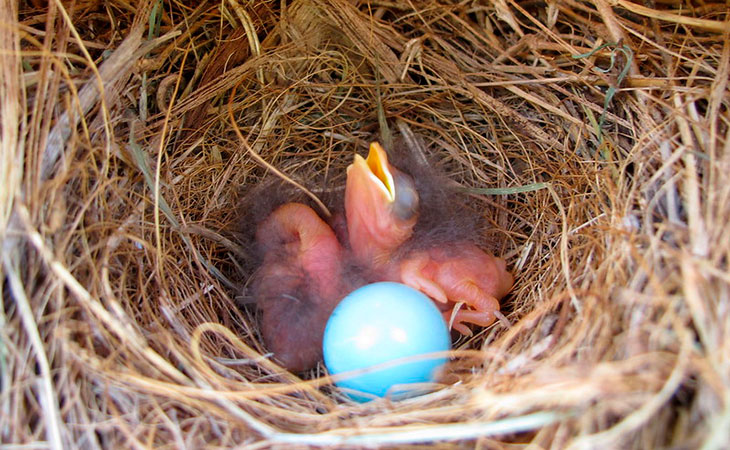
Bluebird eggs hatch inside a menses betwixt 24 to l hours. Chicks hatch bullheaded and naked.
Both parents take care of the young and feed them with a diet rich in proteins, by and large insects.
Nestlings grow fast and leave the nest in about 16 to 25 days, depending on the region. After they fledge, parents continue taking intendance of the fledglings for about three weeks until they become independent.
How long does it take for bluebird eggs to hatch?
The incubation menses is variable within the Bluebird'southward ranging betwixt 11-xix days with an average of xiii.five days. Bluebirds in the warmer southern states have slightly shorter incubation periods than those in colder northern regions.
The female Bluebird starts incubating the eggs on the last or day earlier last she lays the terminal egg. She lays ane egg every day but does not sit down on them.
The female does all the incubation of the eggs. In one case the egg hatch, she broods the nestlings continuously until approximately day 5-7 after hatching, when the nestlings begin to have some thermoregulatory control over their body temperature.
The male is ever around bringing food to the female while she incubates the eggs. So, the male besides brings food for the brooding female and the nestlings during the showtime days after hatching.
Egg hatching
Hatching begins 1 to half-dozen hours before the chick emerges completely from the egg.
The female person incubates all the eggs for well-nigh the same catamenia of time, ensuring that eggs hatch as shut to each other as possible, eliminating the size advantage of chicks that hatch starting time over those that hatch last.
Blind and by and large naked.
Bluebird chicks at hatch are blind and mostly naked with patches of gray down. They weigh approximately 2.4 gr (0.08 oz).
Infant bluebirds are "altricial," which means that nestlings are entirely dependent on their parents until they become nutritionally independent and can find food for themselves.
Both parents work equally to feed the chicks.
Both parents feed the chicks from day 1, but the male does most of the work during the first v days afterwards hatching. Equally in other birds, chicks open their oral fissure wide when they sense one of the parents in the cavity.
Studies of the breeding biology of nesting bluebirds indicate that both parents accept near the aforementioned number of trips in and out of the cavity.
The same studies noted that the female alternates feeding with brooding the immature birds during the starting time week as they cannot regulate their body temperature.
After a calendar week, the immature birds can regulate their body temperature, and the female does not have to brood them all the time, although she spends the nighttime with them.
Parents appear to take more feeding trips and be more active during the early morning hours. The feeding continues in the afternoon but not as ofttimes equally in the morning.
Foods fed to nestlings.
The parents bring crickets, spiders, grasshoppers, butterflies, and moth larvae, also as berries such as raspberry, mulberry, dogwood, cherry, and honeysuckle.
The diet of nestling bluebirds is high in protein, consisting of approximately 68% invertebrates and 32% berries. A high protein diet helps chicks abound as fast equally possible and leave the nest soon.
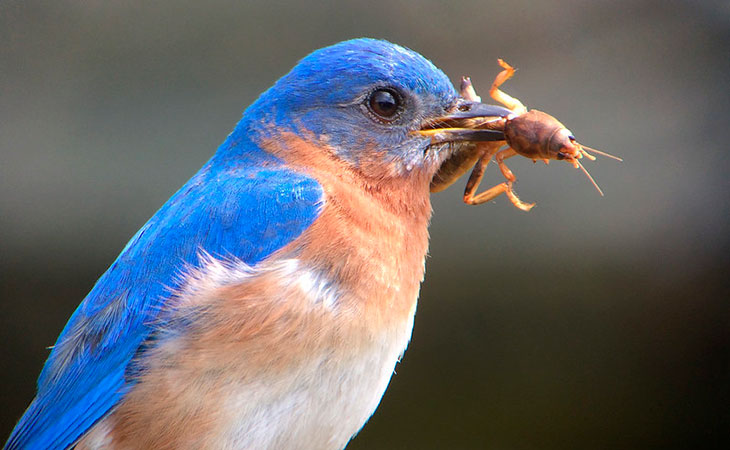
Photo: Festive Coquette/Flickr/CC by ii.0
Nest sanitation.
Iv to v chicks defecating in a small cavity would brand a big mess, only both parents clean upwards the cavity throughout the solar day.
Equally it occurs in many birds, right after chicks are fed, these turn around to present the parent with a fecal sack or pellet. The fecal material is encased in a bag-like gelled parcel the parent takes with its beak and drops far outside the nest.
When the chicks are very young, parents will eat the fecal sacks, simply this exercise ends as the chicks get older and are fed various food items.
If one of the chicks dies, ane of the parents, when possible, pulls it out of the cavity and drops information technology exterior the nest.
How fast practice nestling bluebirds abound?
Bluebird chicks develop fast. After hatching, young bluebirds begin making calls loud enough to be heard when parents arrive with food.
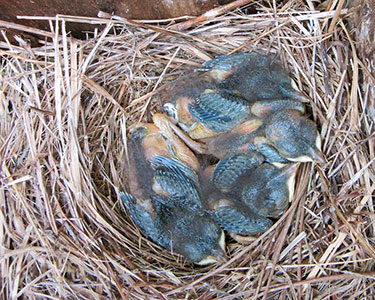
Feathers brainstorm to grow and replace the gray down past day 2. The nestlings open their optics past days v and vi. By twenty-four hours vii, the chicks have short feathers in most of the body'south back and sides. By solar day 13, chicks are completely feathered.
By day 13 and older, male and female immature bluebirds tin can be told apart based on their plumage color.
Leaving the nest comes next.
As with the onset of the breeding season, the historic period at which chicks leave the nest varies with latitude.
Bluebirds in northern portions of the species range start nesting after, take slightly longer to hatch, and appear to take a lilliputian longer to leave the nest than birds in southern states.
Yet, the deviation is small.
Across the species range, young Bluebirds leave the nest betwixt 16 to 21 days after hatching.
Because all chicks hatch at almost the same time, size differences amongst chicks seldom develop. Chicks of the same historic period and size leave the nest simultaneously.
Parental care afterward fledging.
Parents and young bluebirds stay together after fledging for about three weeks.
After leaving the nest, young Bluebirds remain in a relative hide for the first week or and so. The parents bring food to the fledglings, which are easily located by their persistent calls.
During the first week after leaving the nest, fledglings withal depend entirely on their parents for nutrient. They brainstorm practicing flight from place to place.
After the first week, the young birds begin to follow the parents to more than open spaces. The young Bluebirds also first performing the typical sit-wait-and-drib strategy to take hold of invertebrates.
As fledglings gain experience obtaining their food, the parents feed them less and less.
Once fledglings become nutritionally contained, they take trips further and further from the family unit unit later about iii weeks.
So, the young bluebirds join flocks of juvenile birds that move virtually in the region.
Field observations accept noted that chicks hatched late in the summertime may remain with the parents through the winter.
Overall, the time information technology takes for young Bluebirds to dissever from their parents is variable.
Some fledglings stay in the family's territory for a long time, while others bring together flocks of juvenile birds and exit the family unit of measurement in about 3 weeks.
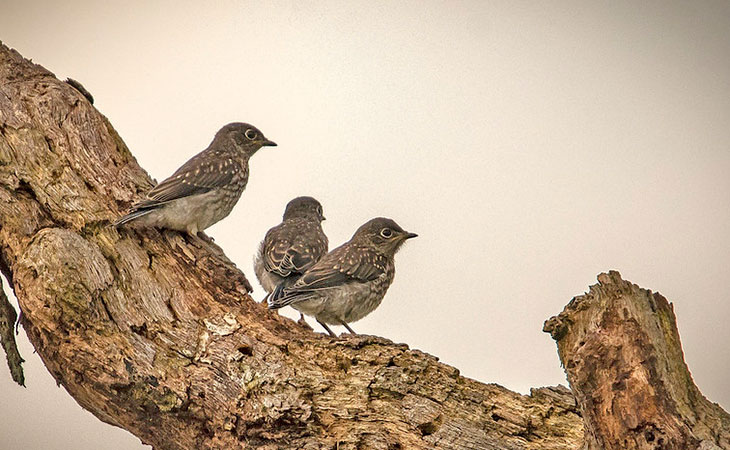
Photo: Wendy /Flickr/CC by 2.0
In the event that one of the parents dies, what volition happen to the eggs or nestlings?
The effect on the eggs or nestlings varies depending on when and whether the male or the female goes missing. This is because the male does non incubate the eggs nor brood the young.
Disappearance when the pair has eggs in the nest
When one of the parent bluebirds dies or disappears during the egg-incubating menstruation, the nest fails, and the remaining parent is likely to notice a new mate and start another nesting attempt. The male does not incubate eggs, and the female person could not incubate, brood, and feed the young without the male bringing food.
Disappearance when the pair has nestlings
When a parent dies or disappears when they have nestlings, the possible effect depends on the age of the immature bluebirds.
Generally, the remaining parent will try to get a replacement mate to help raise the brood.
Possible outcomes include:
- If the female disappears when the nestlings are less than 7-8 days erstwhile, the nestlings are likley to die because they are unable to thermoregulate their body temperature. While the male will proceed feeding them, he does breed them at all. Ifthe female disappears afterward the 8-12 day, the nestling exercise non need brooding and the male alone is probable to raise the breed on his own.
- If the male disappears when the nestlings are less than vii-8 days old or older, the female person may be able to raise them lonely, although she could fail.
Both the widow male or female can enlist the assist of a new partner that helps them raise the young. The new partner'due south interest is acquiring a territory and having the next brood with parent they are helping. Partner helpers do help just not as energetically equally they woudl if the nestlings were theirs.
Helping a widow raise his/her young is a way for "floaters" to larn a territory. A floater is an adult bluebird gear up to breed simply does not have a mate or territory.
Older siblings may assist parents raising the new brood.
Some other observation of these studies was that young birds of the previous breed, still in the parents' territory, may help feed their younger siblings.
This behavior appears not to be common and happens more oftentimes in certain habitat types and atmospheric condition than in others. The actual help older fledglings provide is also in uncertainty. Information technology may be that young birds practise this as a manner of practicing for when they become parents.
If 1 of the parents disappears and older fledgling are around, they are probable to assistance raise their younger siblings.
References:
- Eastern Bluebird, Life History. All About Birds. The Cornell Lab of Ornithology.
- Gill, Frank (1995). Ornithology. New York: W.H. Freeman.
- Sialis Online. Bluebirds.
- The Birds of the World Online. Eastern Bluebird (Sialia sialis). Cornell Lab of Ornithology, Ithaca, New York.
LEARN MORE:
Source: https://avianreport.com/bluebird-parental-care-hatchlings-nestlings-fledglings/
0 Response to "Do Baby Bluebirds Leave Nest All at Once"
Postar um comentário